Saturday, February 16, 2019

Triathlon Training Update

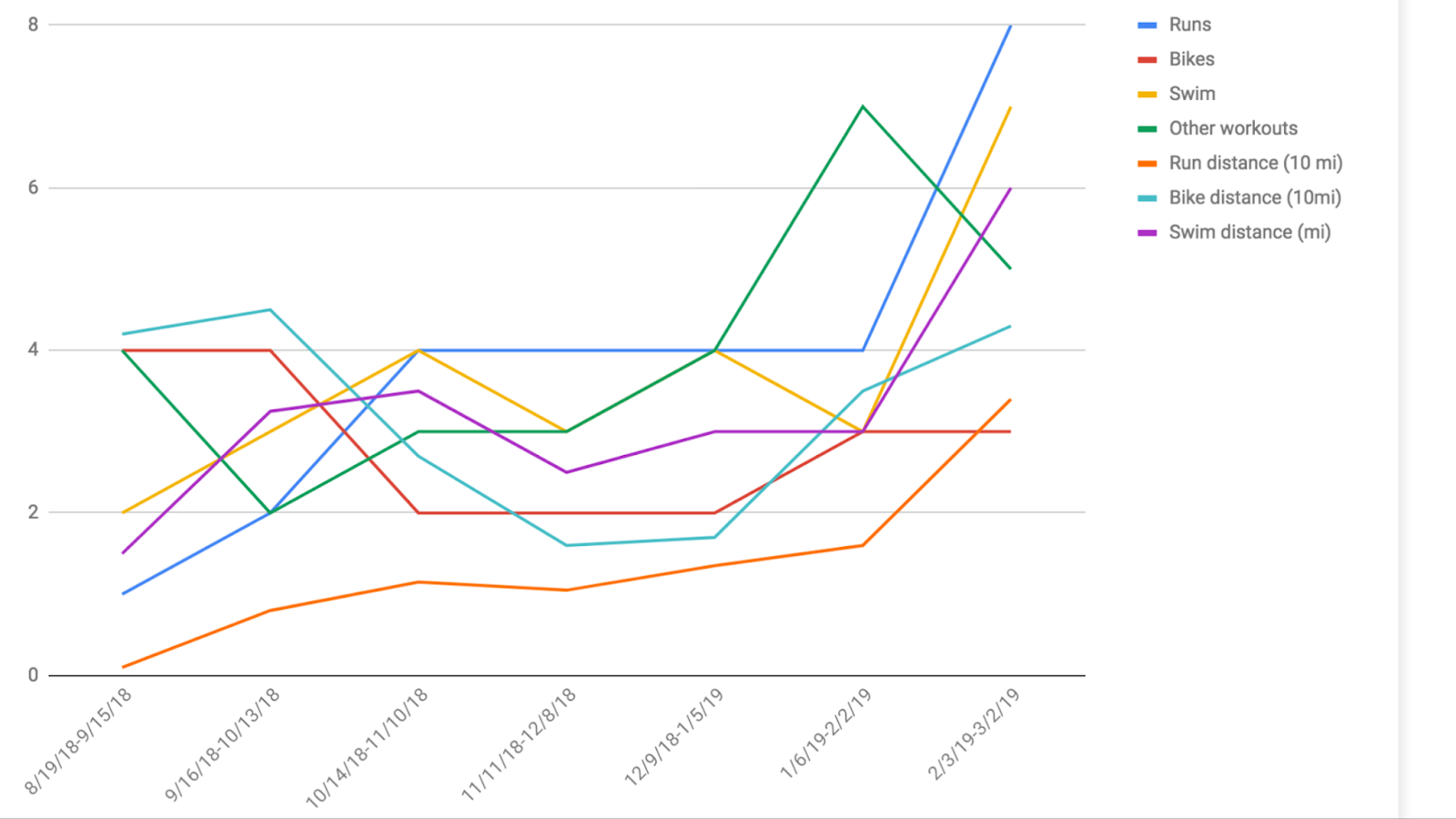
I've been doing some pretty serious triathlon training over the last two months. I actually overtrained early in February and ended up having to take a few days off to recover, but have been stronger than ever since. This graph is the fruit of my desire to see objectively how much harder I've been working. Though not all of the lines will keep going up as precipitously as they have recently, it is nice to see some movement in the right direction.


Runs:
One thing you'll notice is that my running gradually ramped up until last month, then drastically jumped from 16 miles to 34 miles. Though that's still not very much (less than 10 miles per week), I'm starting to build my base for the upcoming season, and feeling much better on runs than I did just six weeks ago. My longer runs are getting longer, my pace is quickening, and just last week, I started doing interval workouts, which I'll slowly intensify over the coming months. The major issue I'm encountering is calf tightness, so I've been spending a few minutes most days rolling out my calves on a dumbbell handle to keep them loose. I have also been integrating runs with either bikes, swims, or other workouts, which are called "brick" workouts, since these sessions build strength and endurance so effectively-- and since your legs feel like bricks when you start to run after biking. Here's once brick workout I plan to start working into my routine once it starts to warm up outside. The run is probably the most important component of the triathlon, and it's where I hope to make up some ground after what will no doubt be average swim and bike legs.

Bikes:
Biking in the winter in Boone is a challenge. Only one day of out 10 ends up being 1) at least 40 degrees, which is my cutoff to avoid hypothermia and frostbite, and 2) a day I'm not working or otherwise occupied. All I've been able to manage over the winter is to maintain a base level of biking fitness. If I had access to a stationary bike or a bike trainer stand, I would be putting in more miles, but that's not an investment I've made yet. I will be putting my primary focus on bicycling and brick workouts over the next few months, and will ratchet up my interval work and distances on my long rides. Long-term, I do get nervous thinking about the risk of a major crash, but I'm doing all I can to be a safe rider.

Swims:
Because the weather has been so cold over the last month, I added a few swim sessions that would have otherwise been biking sessions, and ended up setting personal records in the mile swim twice in the course of a week (36:15 then 35:45). I have settled into a pattern of alternating my custom ladder workout (200m-150m-100m-50m-100m-150m-200m-150m-100m-50m with 75 second breaks) with short, high intensity intervals of 25 to 50 meters (often using a modified "head-up" freestyle stroke which isolates my shoulders and builds shoulder strength), distance swims of 1-1.5 miles, and ancillary work like backstroke with flippers and breaststroke. I've obviously been putting in enough time in the pool to make some significant gains this year, which has been a welcome surprise! I occasionally feel a twinge in a rotator cuff, and swimming surprisingly contributes to my aforementioned calf soreness, but I haven't been dealt any major physical setbacks in the pool. I hope to keep my momentum going over the coming months, but don't anticipate increasing my swimming frequency given time and energy constraints.

Other workouts:
To evolve into a good triathlete, I am going to need stronger shoulders for the swim and stronger legs for the bike (and run). I have been focusing my efforts on exercises like pull-ups, squats, and powercleans, with the occasional dumbbell snatch or thruster workout to round things out. I limit my recovery periods, so my workouts are mostly metabolic conditioning sessions of the type popularized by Crossfit. Since my workouts tend to be less than 30 minutes, I often pair them with a run. One exercise I particularly value is the "man-maker," (which I taught my college friends on a recent get-together), which consists of one-armed dumbbell rows, a push-up, a squat clean, shoulder press, and lunges. I like to do 3 or 4 sets of 15 with a 30-pound dumbbell, which is more reps that I was able to a year or two ago... so I am getting stronger! And just as important, I do a little MovNat mobility work every morning, and a whole MovNat workout or yoga session from time to time to stay supple.

Races:
Unfortunately, it doesn't look like I'll be free to do the Lake James or Watauga Lake triathlons this year, but I am planning to do the Huntersville Sprint on 4/28, the Smiley Sprint in Clemmons on 6/9, the Lake Logan International (a longer race) on 8/4, and finish out with the Lake Lure Sprint on 8/10. If all goes well this season, I may be looking at some half-ironman events next year... but I don't want to jinx it. For now, I'm content with entering triathlons as motivation to train harder and get stronger, although it would be nice to be a competitive triathlete and an ironman one day. Or perhaps I'll find something else to motivate me in the future. For now, the triathlon is the thing.


To those of you who couldn't view the graph above, here it is in a different format:

Thursday, February 14, 2019

Deluge

In the time of the Great Extinction,
There dwelt a woman favored among sapiens,
Hana, a lady of Wisdom and renown,
Foremost of her kind,
Blessed with the gift of prophesy.

She read the signs in the heavens
Events foretold by the least of the creeping things
How violence and pollution,
Seen as an inevitable nuisance by sapiens,
Was to be the undoing of all the Earth.

Wisdom instructed her to build a craft,
A complex of wise design
Sufficient for 1500 years of life.
Wise women and men came from the six continents
To lend their knowledge, sit at her feet, and grow in Wisdom.

The Deluge came in Year 0.
Wisdom shut her in with her colleagues,
And for 400 years the Deluge fell and raged,
Reducing the bountiful diversity of the Earth
To a remnant of adaptable survivors.

The Earth purified herself from centuries of sin.
The righteous species perished with Homo sapiens,
A species ill-named-- knowledge without wisdom,
Bent towards violence and pollution.
All were sacrificed but the remnant.

The sacrifice made, the Earth was cleansed
Another desecration, another recovery
She offered sapiens a mountain for our new home
A chance to be righteous and wise,
Avoid violence and pollution, and walk in love.

Wisdom preserved a remnant
Sealed in a wisely constructed craft
Hana preserved only the wise ones
With seven pairs of each righteous species
Carefully selected from a vast but shrinking number

Ravens were the first to survive outside the craft,
Later, doves made their home on the high mountain, and flourished.
Another century, and the swallows adapted to the Earth's offering.
Then the people of Hana came forth from the craft, two by two,
With all the other righteous species, each according to their kind.

Hana, breathing the clean air, drinking the pure water, and tasting the fruit of the rich soil,
Offered herself as a sacrifice to the Earth.
The Earth was well pleased and took Hana to herself.
Her comrades walked in the way of the Wise,
The practice of righteousness, love, and flourishing.

Other mountains were cleansed
And the valleys made ready for the coming of the children of Wisdom.
Still we build, maintain, tear down, and remember,
Wisdom and the Earth our instructors
In the way of righteousness, love, and flourishing.

The sacrifice made, the Earth was cleansed
Another desecration, another recovery
She offered sapiens a mountain for our new home
A chance to be righteous and wise,
Avoid violence and pollution, and walk in love.


<To those of you who are very confused right now: this is a mythological poem set in the distant future after an environmental catastrophe. Hope that clears things up! -DG>

Saturday, January 19, 2019

Reapproaching Genesis 1-11

Image result for the jewish study bibleImage result for reading the bible again for the first timeRelated image


Over the past few weeks, I've delved deeply into the world of Genesis. I've primarily drawn upon Reading the Bible Again for the First Time by Marcus Borg, the essays and textual annotations in The Jewish Study Bible, and "The Bible Project" podcast's "God Series" episodes. The first few chapters of Borg's book offer the best overview of how to properly read the Bible, while laying bare the bankruptcy of the literal, fundamentalist reading that came about in the 19th century. The Jewish Study Bible contains hundreds of pages of textual criticism, most of which I read or skimmed. The Bible Project podcasts do a particularly good job of detailing ancient Hebrew conceptions of God, and how they differed from the modern Christian concept of God.

Here are some of my takeaways:

- The Bible should be read in a historical-metaphorical sense. We should allow scholarly criticism to inform our understanding of the Bible's historical context, while also engaging with the text in a dialogical manner. This means contemplating the range of mythic meanings the text engenders, critiquing the text as a human document, and allowing the text to challenge us and point us to God.

- Genesis has not one, but at least 4 fall narratives: Adam and Eve, Cain and Abel, the "sons of God" taking women as wives, and the Tower of Babel. Each of these brief narratives highlight different aspects of the problem that we face as fallen creatures, and the allowances God made for it.

- Ancient Hebrews conceived of a "divine council" headed by Jehovah but composed of other spiritual beings, who we now call angels. The "sons of God" taking women as wives is actually a fall narrative of some of these spiritual beings. In contradistinction to humans desiring to become spiritual beings or reach divine status, these spiritual beings desired to become physical and mate with human women, again upending the natural order.

- The dominant source theory for over a century has been that of Julius Wellhausen, who in the late 19th Century postulated four sources of the Pentateuch (Genesis-Deuteronomy), which were later weaved together with very light editing in the post-exilic period. These consist of the J (Yahwist) source from the 9th century, the E (Eloist) source from the Northern Kingdom in the 8th Century, the 7th Century D (Deuteronomist) source, and the P (Priestly) source from the 6th-4th Centuries BCE. Though postmodern and Jewish criticism has pushed back against some of the implications of his theory, it remains the most useful tool in resolving and understanding the conflicts and contradictions evident throughout the Pentateuch.

- The histories recorded in the Bible, especially prior to Solomon's reign, often do not match up with archeological and other extra-Biblical textual evidence. Though literalist scholars go to great lengths to try to resolve these differences (as they try to resolve the contradictions throughout the Bible), it is far more reasonable to view the narratives in the Pentateuch as mythologized history, in which the lessons the stories teach are the primary concern, rather than the historical accuracy of the events.

- The Bible is far more interesting and infinitely less distressing when read as a human document with the above ideas in mind, instead of thinking of it as magically divine in origin. And this drives at the core of what it means to have faith and be a follower of God. If we believe that what God most wants from us is to believe highly problematic statements to be factually true, we will ultimately leave the faith, as I did for a time. But if, instead of seeing faith as intellectual assent to a particular dogma, we understand faith as a trusting and deepening relationship with the God to whom the Bible points, the Bible becomes and inexhaustible source of challenge, meaning, and truth.