Thursday, January 9, 2020

The Best Thing I Read in 2019

I read a lot of articles, quite a few book summaries, and a fair amount of actual books. I love few things more than digesting a good blog post or quality book. And if I was asked to recommend just one thing I've read over the past year, Tim Urban's series "The Story of Us" on his blog "Wait but Why" would be it-- hands down. Here's the link: https://waitbutwhy.com/2019/08/story-of-us.html

Below, I do explain this picture.

The reasons for this selection are many. First and foremost, the topic is one of utmost importance: the underlying reasons why our society is heading in the wrong direction. Urban deconstructs the psychological, historical, cultural, anthropological, and technological dynamics that have brought us to our current state of affairs-- which by his and most other accounts is the brink of societal collapse. The number of mental models I gained or reinforced as a result of reading this series by far exceeds any other collection of writings in my recent memory. And I can't think of another series with as many "aha" moments as this one. And finally, like most of Urban's writing, it's fun to read. Hilarious, even.

Though a summary would take far too long, a couple takeaways I will mention is that the level of consciousness of individuals, organizations, political commentators, news outlets, political parties, and politicians matters far more than where on the "right/left" spectrum they are. Is their "higher mind" (symbolized by the guy with the turquoise light above) in control? Or is their primitive mind (you guessed it-- the orange flame-carrying blob) calling the shots? Another idea is that confirmation bias, rather than truth, becomes the driving force when the primitive mind takes over an individual or a group, which instigates a feedback loop which becomes ever more difficult to break as time goes on.

Urban isn't actually finished with the series, either. In the two final posts, it seems that he intends to offer his prescriptions for how we can break the cycles that have fractured our society. If you get a chance to read the series up to now, I think you'll be anticipating this as much as I am. Happy reading!


Sunday, December 29, 2019

Off-season triathlon training

The past 4 months have constituted my off-season, and as such I've focused on preparation. First of all, I've been able to stay healthy. Secondly, I've undergone a professional bike fitting and aerobar installation, which I'm optimistic will keep my back spasms more at bay on long rides. In an effort to focus my training, I've also picked out the four triathlons I'd like to do next year: one Sprint triathlon, two Internationals, and one Half-Ironman. I also committed to a 6-person 100-mile relay race from Hickory to Boone with my brother David in March. As a result, I've been mostly focusing on inching my run mileage and intensity up over the last 2 months, and am starting to see improvements in my workouts as a result. Just yesterday morning, I had a very nice interval workout on the Appalachian State intramural fields in perfect "Indian Summer" weather.

I've also been more consistent about high-intensity interval training, and have integrated farmer's carries and overhead carries into many of my workouts in an effort to strengthen my upper body and core. I'm hopeful this upper body work will translate to some gains in the water. I've even started developing callouses on my palms from the weights, which has been peculiarly satisfying!

With a new baby in the home, recovery and workout timing has particularly important. As I am able to sleep more on my work weeks thanks to Mindy's willingness to shoulder the baby's nocturnal feedings, I am better able to recover from workouts on my work weeks than I am when I am sleep-deprived on my weeks off. I've also found that a sleep-deprived workout is often hardly worth doing given how sluggish I feel. So I'm squeezing as many work-day workouts in as I can.

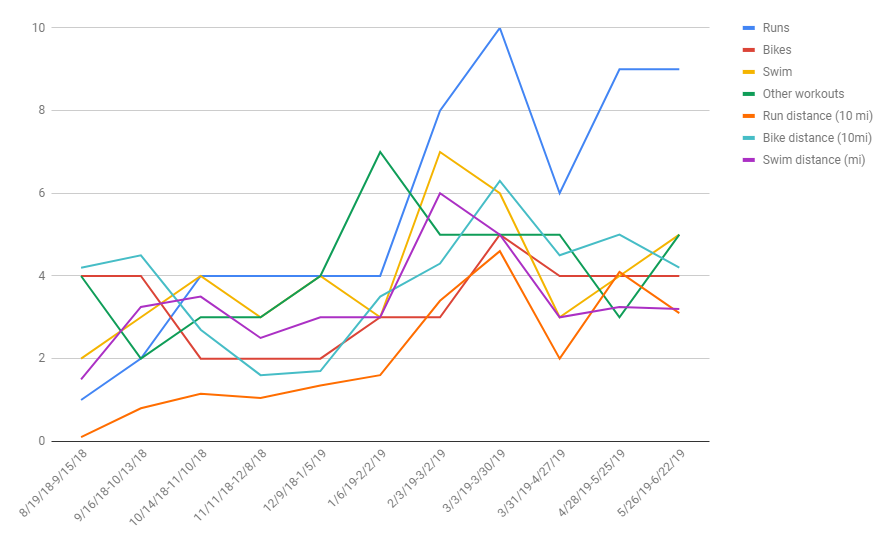
True to form, here's the graphical representation of my workouts over the last 4 months. The main takeaway is that I'm starting to run more. Hopefully the other lines will be on an upward trajectory too in my next update!


Monday, November 25, 2019

My Cry From Trumpistan

An unexpected thing has happened over the past year: I've become a political junkie. Like most people, I used to keep track of the primaries once people actually started voting, tune in for a debate or two, and scan an article here and there. But at some point in 2019, I started reading The New York Times and scanning a few other political websites on a daily basis. And though part of me would prefer reading non-political articles and books, I don't see myself getting off of the political treadmill for very long until next November, at the earliest-- but probably much later than that.

The reason I've lately felt so pulled in a political direction is that the post- Cold War world order dominated by America that I've known my entire life is shattering. Dozens of countries all around the world that a decade or two ago seemed on the verge of developing into semi-stable democracies have either plunged back into the darkness of authoritarianism or are teetering on that slippery ledge. Perhaps the most stable democracy of them all-- the USA-- has elected an amoral strongman who daily chips away at our democratic norms, traditions, and laws, one trolling tweet at a time-- who consistently favors murderous dictators over longtime alliances, his own uninformed and twisted judgment to wise counsel, and personal benefit over national security.

And the most mind-blowing thing of all is that, over the past decade, the Republican party has gone from a fairly reputable organization that at least paid lip service to real values like truth-telling, ethical behavior, fiscal conservatism, free trade, humanitarian values, international engagement, and military strength, to a personality cult, the focus of which has consistently undermined every single one of those values. Though Trump's approval rating has stayed under 45% since taking office, a majority of Fox News- watching conspiracy theory- touting rural Republican voters still love him-- despite the fact that everything and everyone Trump touches gets contaminated. Every single politician or bureaucrat who has gotten pulled into his orbit, even the most respected general of his generation, James Mattis, is disgracefully disgorged from the Administration just months later. The pattern is striking in its consistency. Half a dozen of his closest aides are already behind bars, and more are sure to follow. Yet there seems to be no end to the procession of power-hungry dupes ignorant of history willing to bend the knee for a scrap from Trump's table, heedless of their own impending fall. And this is just one of many details of the Trump administration that seem to defy explanation.

Sooner or later, Trump will no longer occupy the White House and Republicans will lose power. Though this should console us on some level, what happens after this transition is actually the most concerning thing of all, because the majority of rural voters in this country will then feel more disempowered than ever. As their 45% share of the electorate dips below 40%, some on the far right may no longer feel that they have anything to lose from taking to the streets in bloody protest. The violence we saw in Charlottesville in 2017 and the surging gun violence of our time may then be viewed as a modest warm-up to the conflagration that followed.

A little less surprising, but just as tragic, is how the so-called Christian right has walked lock-step with the Republican party into amoral oblivion. If we needed a modern-day echo of the 4th-century corruption of Christianity by way of complicity with the Roman Empire, look no further than the late-20th and early 21st- century evangelical-Republican alliance. Though Trump will be out of the picture before too long, the wreckage of evangelical Christianity in America will remain, and will only continue to worsen as long as scientifically obvious facts such as evolution by natural selection, psychologically damaging dogmas such as eternal conscious torment for all non-Christians, simplistic salvation formulas, and a narrow literalist approach to the Bible continue to be defended. The moral bankruptcy of the sanctimonious Christian right will continue to be on full display to all.

In case I needed more cause for concern, the climate crisis is quickly zooming past the tipping point. Yet, beholden to the oil companies and unable or unwilling to reason clearly, one of our two major political parties (alone in the entire world) denies the irrefutable existence of the crisis, the equally irrefutable case that humans are causing it, and the solutions that are truly our only hope of survival. Consequently, Republicans have reversed as many Obama-era environmental protections as they can over the past three years, squandering precious time-- which the planet can simply no longer afford.

Political stability and the Earth itself are slipping from our hands. We are truly declining, more precipitously than anyone two decades ago imagined we could. Nihilist fascism is being effectively exported from Russia while repressive Communism rises out of the East. Our country is descending into Trumpistan, too paralyzed from polarization to even agree on a shared set of facts, much less respond to mortal threats external and internal. And the left, which should be seizing this hour of destiny with moral authority, often seems more interested in enforcing uncompromising ideological purity tests upon its own members. Free speech itself, the backbone of liberty, is suffering as a result. Yet "free speech" of the most toxic and insidious kind has never gotten more play on Facebook that it is getting now. Democracy itself, not to mention the mental health of tens of millions of impressionable teens and preteens, is under concerted attack by Mark Zuckerberg and his ilk.

There are a few bright spots. Young people are leaving the Republican party and certain toxic evangelical churches in droves, progressive Christianity is mounting a comeback, and appreciation for science, secular ideals like pluralism, and humanitarian values is on the rise among millennials and Generation Z. Women continue to be empowered. Equal rights for members of the LGBTQ community is becoming a given. Advances in science and technology are accelerating. Electric cars are on the roads. Cultured meat is hitting the shelves. The ubiquity of plastic is being challenged. Alternative energy is thriving. Heck, wolves and elk are even making a comeback.

But for every one of those gains, I hear a story about heavier deforestation, desertification, and pollution, a new humanitarian tragedy, and a dozen more newly endangered or extinct species. Then the next superstorm hits the Caribbean and another fire consumes the West. So I write this post out of a slurry of resignation, frustration, concern, and yes, a little bit of hope. Hope that enough minds will be changed by reading articles and posts like this one that the ranks of world-saving movements will swell and hate groups will shrivel. Hope that more people will open up to reason, science, and universal love. And hope that humanity can arrest its descent into ruin, if we still have time.

Monday, September 16, 2019

Waking Up

The foci of my ruminations for the past month have been the connections between meditation, social and emotional intelligence, and metacognition, which is the awareness of one's own thought processes. A key insight I have gained is that emotional and social intelligence are the corollaries of metacognition in the realm of the heart-- the high-level skills that enable true understanding and mastery. And meditating mindfully develops insight into each of these areas.

How does it do all that? It's quite simple. Mindfulness meditation is simply the act of becoming aware of the processes of own's one consciousness, which includes any physical, emotional, and cognitive stimulus that reaches the level of awareness. Every appearance in consciousness is perfect fodder for mindfulness, whether it be a sensation such as pain, sleepiness, sound, or visual stimuli, an emotion like anxiety or happiness, or a thought like a thing on today's to-do list or something stupid you said yesterday. And therein lies the secret to why mindfulness benefits people across so many different domains. With practice, meditators become more sensitive to their own emotional, physical, and cognitive states, which creates a question where before there had not been one: is this the state of being in which I want to remain? Or put differently: If this were my last day on earth, is this what I would want occupying my time and attention? Without this awareness, we remain lost in thought and at the mercy of our mercurial moods.

Of course, sometimes you have to do the laundry, take out the trash, and call in to that meeting. But even the mundane can be lived in with a beautiful, open state of awareness and sensitivity. I often see this in Mindy. When I call to check in with her at home, she is almost always eager to connect and open to deeper conversation. And the same holds with her when friends and family call-- if they need an empathetic ear, they know they can count on Mindy to provide it. Over the course of her life, she has cultivated this posture of empathetic openness even with fraught relationships, which I've been deeply impressed by time and again. And a little envious of-- but I'm starting to improve in that area, thanks to her influence.

Another cornerstone of emotional intelligence is the ability to delay gratification, which is something I can remember possessing even as a young child. No doubt this capacity played a large role in getting me where I am today-- it's been shown to be more strongly correlated with educational, social, and professional success than just about any other factor. This was one of the main points of the book by Daniel Goleman I just finished, Emotional Intelligence. Another, related point is that the security of attachments in the first four years of life exerts outsized influence on the rest of one's emotional life. So-- thanks, mom and dad! Knowing the kinds of people you were / are, I know you got me off to a great start, even though I don't remember it!


There were many other insights to be gleaned from that book, so check it out if you haven't read it. He gives a nice overview of the neurology of emotions, has a great chapter-length summary of John Gottman's research on healthy relationships, and gives helpful tips on how to navigate the workplace in an emotionally intelligent manner. But the highlights of the book for me were his prescriptions on training children in emotional intelligence both at home and school. If you're a parent or teacher, the last two chapters of the book are a must-read.

One of the modalities he touches upon is meditation-- specifically, its benefits upon children's ability to pay attention in school. Having just listened to Sam Harris interview him on the "Making Sense" podcast, I know that in the 24 years since he wrote the book, Goleman has seen and been impressed by the range of benefits of meditation. If he were to revise the book, no doubt meditation would assume a much more prominent role in his discussion. 


So with all that said about meditation, I've finally started doing it in earnest. So far, I haven't missed a day this month. I've found Sam Harris' Waking Up app to be invaluable in training me how to think about meditation. In particular his progression into more advanced topics is incredibly well thought-out, and he has a clear, consistent, and concise way of communicating ideas that is right up my alley. Convinced yet? You should be! Give it a try and let me know how it goes.


Wednesday, September 4, 2019

Thoughts on The Bucket List


No, this is not a post about the movie of the same name.
The phrase "bucket list" came to my attention, along with many other concepts, sometime during my college years. Until recently, I've unreflectively accepted the idea behind the term, that there are things people want to accomplish before they die. But I've never sat down and made a bucket list of my own because the line between "must-haves" and "would be nice ifs" is always evolving, new ideas are always popping up, and older ideas often lose their luster. Lately, I've come to question the utility of having a bucket list at all, since the things that tend to appears on people's bucket list are not the types of things that make for a deeply fulfilling life. Rather, the bucket list seems designed to engender dissatisfaction with one's normal life and a desire for more exotic and expensive vacations and experiences, feeding the excessive self-absorption of our already overly Instagram-ed culture.

That's my thesis, anyway. Which leads to the following questions: What are the things that make for a deeply fulfilling life? And how can we escape the trap of self-absorption?

My strong feeling is that there are as many answers to these questions as there are people. For me, avoiding social media was an initial step towards less self-absorption. Mindfulness meditation (currently utilizing Sam Harris' Waking Up app) is becoming another important tool in calming mental chatter and realizing the truth of non-duality on both conceptional and experiential levels. And the more the various areas of my life approach the harmony I seek for them, the more fulfillment I experience. Obviously, a healthy marriage is a central goal of my life, one that Mindy and I have been steadily moving toward. To one degree or another on this blog, I have documented other developments in the relational, physical, emotional, intellectual, spiritual, and vocational components of my life, and doing so helps me to clarify my goals and reminds me to stay on track. And it's those things, in sum, that add up to a fulfilling life, more than the "skydiving and Rocky Mountain climbing" about which Tim McGraw so sincerely croons.

But you know, he was spot on in the next few lines of that song... so I'm going to do something I never thought I would do: I'm going to end a blog post with a quote from a country music song. For all the cliches, there are still some things to appreciate about good old Nashville country, and one of them is that they sometimes talk about death, which I like. My mantra for the past year is memento mori: remember death. So when he says, "Someday I hope you get the chance to live like you were dying," I think-- we can-- we all can! And we all should, because living in the knowledge of our impending death has a way of keeping our priorities in order and preventing us from wasting our precious life energy, time, and consciousness on petty things. Anyway, here goes the most improbable conclusion to this post, straight from Tim McGraw's sweet lips:

I loved deeper
And I spoke sweeter
And I gave forgiveness I'd been denying...
And I watched an eagle as it was flying.


Monday, September 2, 2019

Triathlon Season 1 recap

My first full season of triathloning is in the books. The first thing I would say about it is that I'm hooked-- when I was in Copenhagen a couple weeks ago, I watched an Ironman, and experienced some serious triathlon withdrawals-- a sure sign that the triathlon bug has gotten in my blood. It wasn't a smooth season, but the bike wreck I suffered during my first triathlon of the year steeled my resolve to keep racing, and my calf strain during my final few weeks was little more than an annoyance. 

Next, I'm happy to report my final two races went very well! I placed 26th out of nearly 200 and 3rd in my age group in the Lake Lure Sprint, and a little farther back but still in the top 50 out of nearly 200 in the Lake Logan International. I've since taken three weeks off of serious training, but have started back training for next season as of yesterday. And at some point in the past 3 weeks, my calf healed itself. The body is a magical thing.

Now that I've nailed the basics of triathloning, I plan to have aerobars installed on my bike, get a stationary bike trainer of some kind for winter training, and look for a serious training partner and/or a coach to get me to the next level by next summer. If all goes well, I'm considering stepping up to one half-ironman to see what that feels like. I'm looking at doing another four races or so next year-- enough to keep me motivated throughout the spring and summer, but not enough to take over my life.

Below is my final graph of my year of training. You can see a little dip in the spring after I had my wreck, but overall I'm happy with my efforts. Now that I have a solid base in place and plan to do more winter bike training, I anticipate a much earlier rise in my training volume in the coming season, likely in November. In the meantime, I'll be focusing more on kayaking, meditation, gardening, and a medical bedside ultrasound course I'm taking. And blogging!


Tuesday, July 16, 2019

Level up, Part 2: Ideologues and testimonies

Two years ago, I wrote a long post about my personal evolution, delving into topics like stages of faith, spiral dynamics, and healing from spiritual trauma. Since I wrote that post, much of my mental energy has been directed toward understanding the world without the blinders of dogmatism or ideology-- in other words, "Stage 5: Conjunctive" of Fowler's stages of faith. As a refresher,

It is rare for people to reach this stage before mid-life. People here begin to realize the limits of logic and start to accept the paradoxes in life. They begin to see life as a mystery and often return to sacred stories and symbols, but this time without being stuck in a theological box. Individuals resolve conflicts from previous stages by a complex understanding of a multidimensional, interdependent truth that cannot be fully explained by any particular statement.

Now that I've come to grasp most of the core concepts undergirding progressivism and contemplative Christianity, my challenge lies in learning how to share this hard-earned perspective in a loving, humble, but winsome way-- especially with fundamentalists of all stripes. People will always need to feel heard and respected, so truly listening is one of the keys. But assuming that is accomplished, revealing the harmfulness of dogmatism in an emotionally impactful way seems to be the key. This can be fairly straightforward if one is attempting to show a racist or homophobe how their hate hurts another person-- especially if you can expose them to a homosexual or someone of a hated race in a humanizing way. But it gets more complicated when challenging more theoretical beliefs, such as the idea that intellectual assent (and just to be safe, recitation of a formulaic prayer) to a particular group of ideas is the only way to avoid an eternity of conscious torment. This modernist literal interpretation of a few Biblical passages has come to be a defining ideology for millions of fundamentalist Christians, and a challenge to this so-called "gospel" is a challenge to the very core of many people's identity. Which is why it is such an emotionally charged topic.

I think the trick is to make it emotionally charged in a different way. What if we found a way to tell a story that would melt the hearts of the most cold-blooded fundamentalists? Amazingly, I'm starting to realize I have just that. My own story of transformation-- my "testimony"-- is more powerful than any arguments I could marshal against dogmatism, because it is a humanized, first-hand account. I just need to learn how to tell it better!

Just as challenging as religious fundamentalists are political ideologues. Here again, I can draw on my personal experience as a libertarian ideologue (and, years before that, a conservative ideologue) to not simply attack loony lefties or conservative crackpots, but highlight the danger of dogmatism wherever one finds oneself on the spectrum of political beliefs. Time after time, I've seen conservative and/or libertarian ideology drive policy and behavior that can only be described as heinous-- and I've seen it on the left, too. A commitment to truth and love wherever it is found is the one sure recipe for progress, not blind faith in party or person or ideology.

I'll never have it all figured out, but after a fractious 20's, the last few years have proven to be a time of "conjunctive" healing and growth. Pete Rollins uses a phrase that sums up where I am and where I hope I'm still headed: "converted from the need to convert." Though out of convention I accept labels like "progressive" and "Christian," I try to be careful to not let those or any other labels restrict my growth in love, truth, and creativity. Because at the end of the day, that's about all we know God is and wants us to grow in.

Monday, July 1, 2019

Mid-year Update

The garden, training, kayaking, and a few trips have displaced blogging for the past few months, but now that the middle of the year has arrived, I'm making myself post an update on this year's goals. Here goes!

Spiritual:
-Reapproaching the Bible: This deserves a post in itself...but basically, I am constantly learning how to reapproach the Bible through Richard Rohr's Daily Meditations emails and podcasts such as The Liturgists and The Bible for Normal People, and am picking Reading the Bible Again for the First Time back up after a several-month hiatus. I feel that my challenge lies now in learning how to communicate gracefully and clearly in a way similar to two of my biggest influences, Richard Rohr and Science Mike.


-Meditation: Aside from a few random meditations over the last few months, I have let this slide... but plan to hop back on this horse ASAP!


-Personal retreats: Though I haven't yet carved out more than half a day here and there, I'm currently scheduling a 1.5 day retreat for the end of July, a 2.5 day retreat for September, and hopefully another shorter one around the end of the year.


-Generosity: Mindy and I have decided to add another child through Compassion International each year, are increasing our charitable giving, and have been officially approved to start fostering children (see below). In addition, I am also assuming the role of volunteer Medical Director of the local free clinic (Community Care Clinic) where I have volunteered for the last two years.


Relational:
-Mindy: Our communication and fondness for each other is continuing to improve, and I'm encouraged at how we have continued to grow closer. We've also had a couple great trips together this year, one to Wilmington and one to Colorado. Our foster care studying has also sparked some great conversations about our family and life goals. We are also working together on the gardens a lot more and a lot better than ever before, which has been both fun and productive.


-Friends / co-dates: We have started a promising friendship with another couple (the Blands), and continue to hang out with our friends the Hogans on a regular basis, in addition to a few other couples we see occasionally. It was also great to see all our residency friends last week in Colorado.


-Book club: My college friends and I just finished our third book of the year, and it's been fun having people to share my thoughts with and hear what they're thinking. So far, we've read The Road to Unfreedom, Flexible Faith, and Your Money or Your Life-- all of which have sparked some great discussions.


Physical:
-Triathlons: I crashed my bike on my first triathlon in April, which in addition to some gnarly wounds was a gut check on my desire to keep doing them. Fortunately, I had Mindy there to remind me that doing challenging things like triathlons was a core part of who I want to be into old age, and that I want to be that 80 year-old dude who is still racing (and crushing it). So after a few weeks of healing, I got back in the saddle, and ended up placing 3rd in my age group in my second triathlon last month (and was only 2 minutes out of first place). I'm currently dealing with a right rotator cuff flare-up, but otherwise training continues as outlined below:


-Gardening: The thankless stage of preharvest weeding is in full swing, which always makes me question why I garden at all. But I have a very healthy crop of collard greens, carrots, lettuce, squash, kale, and cilantro, and lots of other crops like tomatoes, peppers, and okra are starting to take off:


-Kayaking: I am halfway to my goal of six kayaking trips this year, and anticipate getting closer to ten before the year is done. I have made a couple friends who are showing me the ropes, which helps alot. Next step: learning how to roll my kayak upright from upside down.


-Mushrooms: I've started growing oyster mushrooms on coffee grounds in a more climate-controlled manner, and things are looking promising:


-Bongos: I put in a solid 2 months of practice before life got too busy for it. I'll pick it back up this fall.


-Smoking meat: This has literally been on the back burner, but I'm planning a few smokes for the fall.


Vocational:
Leadership project: My group has nearly completed an important project on the comanagement of patients in the hospital, and I've learned a lot in the process. I've also gained some important mental models as a result of the hospital's leadership program, which will be officially concluding in October.


Family Medicine Residency update: I will be representing the new Boone Family Medicine Residency program at a big national conference at the end of July, and am also leading a transition for procedures such as thoracenteses and paracenteses to be performed by hospitalists, which will be very important in training residents starting in 2020.


Political:
Climate change, environmental activism, and political orientation: As a result of my spiritual evolution, continued reading and learning, and my experience with and education on the far-flung effects of climate change, I have come to see political issues in a markedly different way than the libertarian idealism of yesteryear. Though this has been an important part of my past year, it's too big a topic to tackle here!