Monday, December 10, 2018

2019 Goals

Here we are, again: mid-December, the time my gaze shifts to the new year ahead. This year, I've grouped my goals thematically rather than chronologically:

Spiritual
-Finish Reading the Bible Again for the First Time by Marcus Borg
-Read The Jewish Bible
-Strengthen daily meditation practice, especially Lectio Divina, utilizing The Jewish Bible, The Liturgists meditations, and others
-Go on 3-4 personal retreats, to the nearby Nahimana Forest and the not-so-close Mepkin Abbey in South Carolina and the Hermitage of the Holy Cross in West Virginia

Relational
-Continue to build daily closeness with Mindy
-Continue to build community with friends by hosting dinners and going out on co-dates with other couples
-? Church men's group
-Participate in college friend's book club every 2 months

Physical
-Participate in 3-4 triathlons this summer
-Kayak on the New River 6 times and another river at least once
-Teach myself the bongos, practice 3-4 times per week (most of my off-days)
-Vegetable garden again
-Smoke meat at least 3-4 times
-Forage for mushrooms at least once
-Grow mushrooms in a climate-controlled manner

Vocational
-Engage in leadership program project
-Go through a lot of case studies on my own
-? Pitch Grand Rounds project to hospital leadership in preparation for Family Medicine Residency (set to start in July 2020)
-Identify and start other Family Medicine Residency projects


The big-picture themes for my year are reapproaching the Bible in a new way and generosity of spirit. My goal is to be more empathetic, warm, and understanding by the end of next year than I am now. Though I'll still be reading books and book summaries and posting my reflections, I'll be more focused on the emotional and relational side of life, which is where I stand to grow the most right now. And I hope that, as a result, joy and humor will flow like never before!

Wednesday, December 5, 2018

Dan's Top Ten Lists of 2018!

I would ask for forgiveness for such a clickbaity title, but I'm really not sorry.

Top 10 Memories

  1. Kayaking with Mindy on the Nantahala River
  2. Kevin Lloyd's wedding
  3. My yearly 3-day college guy's weekend (aka "PAW")
  4. Backpacking with Mindy in Uwharrie National Forest
  5. The Goble family beach trip to Oak Island
  6. My weekend visit with Sam Cox, Lee Robeson, and Sam's friend Nick in Raleigh
  7. Kayaking with Mindy on the New River
  8. Visiting my brother Thomas, Lindsey, and my nephew James in Roanoke Rapids
  9. Biking the Creeper Trail with Mindy, Norm, Cassidy, and their kids Calloway and Waverly
  10. Swimming in the Watauga Lake Triathlon


Top 10 Podcasts

  1. The Bible for Normal People
  2. The Deconstructionists
  3. The Liturgists
  4. The Robcast
  5. The New Yorker: Fiction
  6. On Being
  7. The Art of Charm
  8. Ask Science Mike
  9. History of Philosophy Without Any Gaps
  10. Dan Carlin's Hardcore History: Addendum


Top 10 Books

  1. Sinners in the Hands of a Loving God
  2. The Road to Unfreedom
  3. Reading the Bible Again for the First Time
  4. The Mountain of Silence
  5. Mastery
  6. Man's Search for Meaning
  7. Grit
  8. On Writing Well
  9. Evolution and the Fall
  10. Sapiens


Top 10 Apps

  1. Blinkist
  2. Spotify
  3. Pocket
  4. Evernote
  5. Strava
  6. Focus@will
  7. The Weather Channel
  8. Interval Timer
  9. Yoga Studio
  10. Goodreads


Top 10 Shows

  1. I literally only watched one TV show this year, and that was Black Mirror. But it was really good, so I'll keep it at the number one spot.
  2. ?
  3. ?
  4. ?
  5. ?
  6. ?
  7. ?
  8. ?
  9. ?
  10. ?


2018 Goals in Review

Things morphed in 2018 as they always do. Here are my SMART goals (with trips in parentheses) from last December, color coded in green if completed and red if not.


January (into February): Reach Level 2 in the Krav Maga self-defense course (See family in Roanoke Rapids and friends in Raleigh)

February (into March): Write a 1-day course on obstetrics, prenatal care, and neonatal resuscitation I will be teaching for Equip International's Missionary Medicine Intensive course 4 times per year starting in March (2-day marriage conference in Charlotte)

March: Focus on cultivating my marriage and applying concepts from the marriage conference (Camp in Uwharrie National Forest)

April-May: Design and build the library, build a barrel composter, help Mindy build the chicken coop (3-day weekend with college friends, kayak trip #1)

June: Work on my kayaking skills (Kayak trip #2, camp in Elkmont, TN)

July: Start growing oyster mushrooms, experiment with new dishes in the kitchen using home-grown produce (Goble family beach trip)

August: Morning meditation, practicing presence, positivity (Camping trip near Brevard, kayak trip #3)

September: Build a plyo box, lifting platform, and prowler (Trip with Mindy's family)

October: Do the ketogenic diet. It's time. (Backpacking trip with college friends)

November: We may be having puppy grandchildren around this time. If not, I'm sure something will have come up. (Travel to see Mindy's family in Oklahoma and maybe Colorado and Wichita)

December: Do Christmas here and plan for 2019. No trips (hopefully)!


In lieu of the things in red, we built a fence around our 6.5 acres for the dogs, had Lula spayed, bought two rabbits (only one of which survives to this day), biked the Creeper Trail, I did the swim portion of a triathlon, started a leadership seminar at the hospital, visited my friends Sam and Lee in Raleigh, went on a couple personal retreats, and started biking regularly. All in all, the number of projects and trips I ended up completing was the same as the number I hoped to complete at the beginning of the year. So on that measure, the year was a success!

I also feel pretty good about how I explored my dual themes of Creativity and Connection. Mindy and I have grown by leaps and bounds, and I've also cultivated a couple close friendships outside of work. I tried to write a short story but lacked the vision to finish it which was a bummer. But I was inspired to write a poem on Connection after a counseling session, which turned out very well. My many reflections on books and ideas reflect the kind of content I feel most interested in creating at the moment. So on the measure of exploring my key themes, 2018 was also a win!

But the most important metric of a year is personal and relational growth. The activities and themes above were all geared towards these ends, and I couldn't have asked for a richer year of growth. As we wrap up 2018 like a Christmas box and set our sights on 2019, I'd encourage you to outline some projects and themes to focus on, write them down, and review them as they come to mind to see how you're doing. At the end of next year, you'll be thankful for the course you've charted and the progress you've made.


Facebook, freedom, and fascism

I don't want to write about Facebook. You already know the effect social media has on your attention span, and that posts which arouse prejudice and outrage get more likes and shares. If you're like everyone else, you realize from time to time that you should be doing better things with your life, so you deactivate or stop checking your account for awhile, only to crawl back to the feet of Zuckerberg a few weeks later. You know that Facebook doesn't give a damn about your privacy, but you just can't stay away. Perhaps you even recognize this for what it is: carefully-engineered addiction. Social Media Disorder. Maybe even you've seen a therapist for it, and made some progress in curbing your addiction. If so, you deserve to be commended.

But that's not what I'm interested in exploring, because the problem has shifted from an individual and psychological one to a societal and existential one. If you were on Facebook in 2015-2016 and voted for Donald Trump (or for Leave, if you're reading this from the UK), you were likely co-opted by Russian trolls and bots over the course of 18 months in 2015-2016. Hostile Russian intelligence services recruited millions of American citizens into fake online "communities" which spread misinformation and succeeded in driving the narrative of the 2016 election. But this may be old news to you too, and it's also not what I want to write about.

What I want to communicate today is twofold. The first is that healthy civil dialogue in free societies around the world (the US, the UK, most of Europe, Australia, New Zealand, Japan, and South Korea) rests on the foundation of shared facts. And in the era of manipulable mass digital media, this is the soft underbelly of free societies that is being exploited. Donald Trump's never-ceasing torrent of verbal and written misinformation is Exhibit A. Though thoughtful folk like you and me would like to ignore his ravings, that's exactly the attitude that contributed to his election. Donald Trump and his lie machine can be hated, resisted, and (with persistence) corrected at every turn, but they cannot be ignored. He has muddied the very concept of truth by repeating the phrase "fake news" ad nauseum in reference to information very much grounded in reality, while promoting a constant flood of genuinely fake news. And to those of you who may be rusty on your history, allow me to remind you: this is always the first step towards fascism. Mussolini and Hitler are the first to come to mind, but it's also a tactic Vladimir Putin employed eight years ago as he transitioned Russian society into a full-fledged authoritarian oligarchy... around the same time he was funneling millions of dirty rubles into The Trump Organization, coincidently. But I digress.

The attacks on our information systems have no doubt already started to evolve into more sophisticated techniques as Twitter, Facebook, and the government crack down on first-generation misinformation techniques. As Renee DiResta puts it in her article linked below, 

Algorithmic distribution systems will always be co-opted by the best resourced or most technologically capable combatants. Soon, better AI will rewrite the playbook yet again — perhaps the digital equivalent of  Blitzkrieg in its potential for capturing new territory. AI-generated audio and video deepfakes will erode trust in what we see with our own eyes, leaving us vulnerable both to faked content and to the discrediting of the actual truth by insinuation. Authenticity debates will commandeer media cycles, pushing us into an infinite loop of perpetually investigating basic facts. Chronic skepticism and the cognitive DDoS [digital denial of service, a type of cyberattack] will increase polarization, leading to a consolidation of trust in distinct sets of right and left-wing authority figures – thought oligarchs speaking to entirely separate groups.

A sample of memes from far-right communities like Britain First, Sos racisme anti-blanc, Meninist Posts, 4chan, /r/The_Donald, and United Patriots Front.Which brings me to my second point: the theater of this "warm war" is the minds of (currently) free citizens like you and me. Being a war of misinformation and manipulation, it depends on us plugging in and reading, watching, or listening to content generated by fascists (state-supported, homegrown, or both). This is the soft underbelly of the fascist cyberwarriors. If enough citizens wake up, unplug from the torrent of misinformation, and plug into genuine news outlets with legitimate journalists and editorial boards, the fascist cyberwar machine will starve.

This requires each of us to become more circumspect and sophisticated in our consumption of media. Gone is the era when you could blithely scroll your news feed and repost pictures or articles that strike your fancy. We are all going to have to put forth some cognitive effort in evaluating what we consume. Of course, the government also has a giant role it must fulfill. As Renee DiResta puts it, 

We need an understanding of free speech that is hardened against the environment of a continuous warm war on a broken information ecosystem. We need to defend the fundamental value from itself becoming a prop in a malign narrative.
The solution to this problem requires collective responsibility among military, intelligence, law enforcement, researchers, educators, and platforms. Creating a new and functional defensive framework requires cooperation.
It’s time to prioritize frameworks for multi-stakeholder threat information sharing and oversight. The government has the ability to create meaningful deterrence, to make it an unquestionably bad idea to interfere in American democracy and manipulate American citizens. It can revamp national defense doctrine to properly contextualize the threat of modern information operations, and create a whole-of-government approach that’s robust regardless of any new adversary, platform, or technology that emerges. And it can communicate threat intelligence to tech companies.
Technology platforms, meanwhile, bear much of the short-term responsibility. They’re the first line of defense against evolving tactics, and have full visibility into what’s happening in their corner of the battlespace. And, perhaps most importantly, they have the power to moderate as they see fit, and to set the terms of service. For a long time, the platforms pointed to “user rights” as a smokescreen to justify doing nothing. That time is over. They must recognize that they are battlespaces, and as such, must build the policing capabilities that limit the actions of malicious combatants while  protecting the actual rights of their real civilian users.
If that sounds like a tall order for a government crippled by hyperpartisanship and giant technology companies defined by their short-sighted leadership and toxic cultures, I'm with you. But you can do one thing: #deletefacebook.

If you're not motivated enough to quit social media for your own privacy and well-being, perhaps the realization that Russian-backed fascists are using it in an attempt to destabilize our society will outrage you enough to do something. But deleting Facebook is only the start. The foundation of a free society is public discourse with shared facts, and that is under attack. So start spreading the word, and wake people up to the situation we face. Fact check your sources. Stop being lazy. Freedom itself depends on it.


For further reading:
1. An up-to-date analysis of state-supported misinformation cyberwar cited extensively above: https://www.ribbonfarm.com/2018/11/28/the-digital-maginot-line/?utm_source=pocket&utm_medium=email&utm_campaign=pockethits

2. A good overview of how widely distributed right-wing misinformation cyberwar has become throughout the world:  https://www.buzzfeednews.com/article/ryanhatesthis/brazil-jair-bolsonaro-facebook-elections?utm_source=pocket&utm_medium=email&utm_campaign=pockethits


5. An article discussing Facebook's lack of privacy protections after the Cambridge Analytica scandal broke: https://www.theguardian.com/technology/2018/mar/20/facebook-is-it-time-we-all-deleted-our-accounts?utm_source=pocket&utm_medium=email&utm_campaign=pockethits


7. A brief article that highlights many of the main problems with Facebook, with the great quote that "the promise of connection has turned out to be a reality of division."  https://www.vanityfair.com/news/2017/11/the-end-of-the-social-era-twitter-facebook-snapchat?utm_source=pocket&utm_medium=email&utm_campaign=pockethits


9. A discussion of the societal effects of "technologically enabled persistent crowds" on Facebook and Twitter: https://www.ribbonfarm.com/2016/09/15/crowds-and-technology/

10. The difficulties our society is facing as a result of the erosion of trust in our institutions. https://www.politico.com/magazine/story/2018/09/06/common-ground-good-america-society-219616?utm_source=pocket&utm_medium=email&utm_campaign=pockethits

11. The book I just finished reading that exposes over a decade of deep ties between Russia and Trump, along with an exploration of the rise of fascism in Putin's Russia, its war in Ukraine, and its attempt to export fascism to the rest of Europe and the US.  https://www.amazon.com/Road-Unfreedom-Russia-Europe-America/dp/0525574468/ref=sr_1_1?ie=UTF8&qid=1544018305&sr=8-1&keywords=the+road+to+unfreedom

Thursday, November 29, 2018

Late Fall Reflection: Connection and Conflict

Image result for links connecting

As a tribal species, we are wired for both connection and conflict. Sometimes I wonder how a species would function if it were able to evolve beyond its tribalistic tendencies. Would every member of the species quickly develop into an enlightened yogi? Would they maintain the vitality that accompanies intense emotion? How would they respond to existential threats?

The answer to the last question (read: they wouldn't respond as well) is why I think a more enlightened species will never emerge. So, both as individuals and a species, we're forced to work with our wildly outdated hunter-gatherer software. If you think the Space Shuttle's 1970's software was ludicrous in the early 2000's, just multiply that by 2,000, and that's where we are as a species. Each agricultural, cultural, economic, and industrial revolution updated our external circumstances without touching our neurology or biology. Religions developed as a way of adapting ourselves to our complex environment. But sadly, religions have just as often played into our violent biological tendencies as they have helped us transcend them. As Michael Gungor sings in "Let Bad Religion Die,"

All belief demanding blood
If your god gives you a gun
Let bad religion die
If it spreads violence more than peace
God let religion cease.

Whether a faith promotes violence is the best litmus test for its validity. Evolutionary psychology has confirmed the psychological and sociological benefits of the more enlightened teachings of the great religious teachings of the world, such as meditation and charity, while highlighting the damaging effects of violent strands of faith. This new branch of science is a great tool to help us decipher which ideas to keep and which to discard. But I think we can go even further.

Jesus Christ's message of nonviolence and suffering love represents the pinnacle of enlightenment to which monks and yogis of all stripes attest. Though bad theology has misdirected much of Christianity, Islam, and other faiths into the violent rut of our species, there is still hope that the gospel can be reclaimed by a wider swath of our culture. I believe sociologists and anthropologists will ultimately learn that the best society we can aim for given our outdated software involves the inculcation of the gospel values of love and mercy at every stage of human development and every level of society. This is the hack that can sublimate our tribal in-group favoritism to universal love. Though we will need a lot of help from the contemplatives among us, it's this hope that will keep me from despair when I consider the sad state of our species.

Monday, November 5, 2018

Sinners in the Hands of a Loving God Part 3

It took me a year, but I've finally finished summarizing this book. I hope this summary is enough to convey the main ideas-- but you should still put it on your to-read list!

Chapter 7: Anthem of the Lamb

Zahd shifts gears for the last third of the book and deals with a topic near to his heart: Revelation. Having grown up in the shadow of popular dispensational readings of John's apocalyptic narrative, Zahnd understands that many of us require some serious de-education on the topic. Having heard a number of different interpretations over the years, I've simply required clarification on how to interpret the book rather than a complete restructuring, but it was still immensely helpful. Though hardcore dispensationalists out there may resist his interpretation, I found his perspective compelling.

The message of Revelation is more relevant for Americans now more than ever. Simply put, Revelation subverts empire, civil religion, and religious patriotism. Unfortunately, those who are so passionate about their mistaken reading of Revelation are also the most complicit in American empire-worship. The beast, the great whore, and Babylon are all veiled references to the Roman Empire, but can be equally applied to the 21st Century American Empire. As a humble Lamb, Jesus conquers the powerful beast, putting an end to the cycle of one beast conquering another. "The kingdom of God does not conquer the world by the violent means of the beast but by the self-sacrificing way of the Lamb." Clothed in garments stained with his own blood, the Lamb of God is the only one worthy of our worship-- not Caesar.


Chapter 8: War of the Lamb

Zahd continues his discourse on Revelation, turning to the topic of the war which some have interpreted as representing Jesus' violent return, when 200 million people will die in the Middle East and rivers of blood will flow. Fortunately, this is the worst possible misreading of the book. Jesus will never renounce the nonviolence of the Sermon on the Mount, hop on a red warhorse, and slay massive armies. Rather, he is depicted as riding the white horse of victory, with a sword coming from his mouth representing the good news of peace, forgiveness, and reconciliation with God. He vanquishes the unholy trinity of the accuser, empire, and propaganda, depicted as the dragon, the beast, and the false prophet. The whole point of the incarnation and the book of Revelation is that Jesus comes to subvert the violent way of empires and Caesars. Revelation simply symbolizes this process as a war. And "this is not a future war. Christ is waging this war right now."

Unfortunately, that is not how most modern evangelicals read it. And this misreading of Revelation has led many to disastrously condone violence and war, and even hope for a war in the Middle East that will somehow precipitate the New Jerusalem. Does that sound like good news? I didn't think so.


Chapter 9: City of the Lamb

Zahnd concludes his exploration of Revelation with a discussion of the New Jerusalem, symbolized also as the Bride of Christ, and clearly representing the Church. Though the church has been anything but pure over the last two millennia, we nevertheless have been entrusted with keeping and sharing the life-giving gospel of peace. And as the New Jerusalem is depicted as coming down from heaven to earth, so the church is the primary vehicle the divine is using to reconcile humanity to itself.


Chapter 10: Love Alone is Credible

In his wrap-up, Zahd draws on John's meditation that "God is love" in I John 4:8 and 16. Referring to these passages as "the summit of the holy mountain," he reiterates his point that "God is not a bloodthirsty deity requiring ritual killing. Though this may have been the only way we could understand God four millennia ago on the flanks of the holy mountain [where God's only self-revelation was "I am who I am], the truth remains that God is not bloodthirsty; God is love." We have the benefit of Jesus Christ. In contrast to Moses, who said that "no one can see the face of God and live," Paul says that we have seen the face of God in Christ! "John tells us, 'Indeed, God did not send his son into the world to condemn the world, but in order that the world might be saved through him.'"

So the next time you find yourself listening to someone talking about an angry God, please know: that's not the true God revealed in Christ. That God is dead. And may that religion die too.

Friday, November 2, 2018

Reflection on Creativity: Mastery Chapter Five: Awaken The Dimensional Mind: The Creative-Active

A couple months ago, Mindy needed one of her old college books, so I started digging through a few of the cardboard boxes sitting in my future library. As is often the case when digging through old books, I discovered a few forgotten treasures. The one I'd like to write about today was a book I bought in the middle of my residency, Mastery by Robert Greene. I'd read the first chapter or two, but ended up setting it down in a busy and distracted time of life and moving on to lighter fare. It's not a book that can be read distractedly. It's over 300 pages of deep analysis of the stages of attaining mastery-- truly six books in one. He traces the attainment of mastery from "Discover Your Calling: The Life's Task," to "Submit to Reality: The Ideal Apprenticeship," through "Absorb The Master's Power: The Mentor Dynamic." Chapter Four, "See People As They Are: Social Intelligence," was a particularly surprising component of his discussion of mastery, but one which dovetails well with my pursuit of connection this year. His final two chapters, "Awaken The Dimensional Mind: The Creative-Active" and "Fuse The Intuitive With The Rational: Mastery," comprehensively explore high-level aspects of achieving creative mastery. I had so many light-bulb moments reading them. In my vein of exploring creativity, I'd like to highlight a few lessons I learned from Chapter Five.

But first, I would like to note two things. First, the anecdotes in this book are anything but the "fluff" which characterizes the lion's share of nonfiction books out there. Rather, the dozens of biographical sketches sprinkled throughout the book are indispensable in the exploration of his topic. In fact, I can't think of another book that's as layered, complex, yet seamless in its construction. Mastery is a topic that requires real-life examples to understand. It also requires a highly organized approach, which is exactly what the author has attained. In short, Greene displays a masterful grasp of not just the topic of mastery, but also of the craft of bookwriting. I can only describe his treatment of this topic as magisterial.

Second, the following photo captures the most compelling idea bouncing around in my brain over the past few months: on balance, people are either creators or consumers. And if you want to have a shot at an extraordinary life, you'd better be moving toward being a creator and away from being a consumer. That's why I'm writing this blog, and why I pursue so many random hobbies. It's also why I don't watch much television and why I'm off social media, and why I'm bothered by those who lack this sensibility. People who spend most of their lives consuming media created by others atrophy their creative powers and end up dependent on the creativity of others for a sense of vitality.
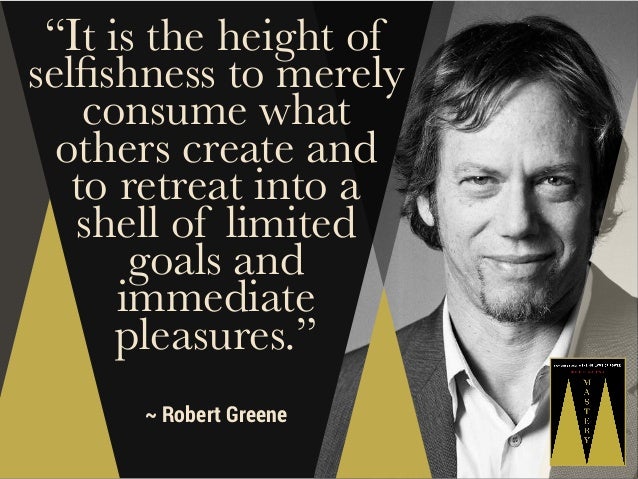
Image result for mastery robert greene

With this motivation in mind, Greene breaks down the three essential steps to attaining creative mastery: choosing your creative task, using creative strategies to loosen and open the mind, and creating optimal conditions for breakthroughs and insights. He finishes by highlighting six emotional pitfalls to avoid and nine distinct approaches various masters have used to attain creative mastery. 

The essential thing in attaining creative mastery is to transcend the "conventional mind" that develops during one's apprenticeship and return to the creative childlike "original mind" with the added knowledge that comes from apprenticeship. But first, we must establish our goal, our life's creative task. This must be realistic yet challenging, open-ended and uncertain, and, crucially, something we are passionate about and which appeals to our sense of unconventionality and "calls up latent feelings of rebelliousness... The sense of having enemies or doubters can serve as a powerful motivating device and fill you with an added creative energy and focus." The creative journey is not for the weak-willed.

Once we find our life's creative task, we must follow the clues to mastery left by the masters who have gone before us. Greene details crucial developmental milestones attained by Mozart, Keats, Edison, Ford, Einstein, Darwin, Da Vinci, Faraday, and Champollion, the decoder of the Rosetta Stone. These include the ability to embrace mysteries and uncertainties and researching as widely as possible to create, as William James expressed it, "a seething cauldron of ideas, where everything is fizzling and bobbling about in a state of bewildering activity." If this can be achieved, "a kind of mental momentum is generated, in which the slightest chance occurrence will spark a fertile idea." An added tack is to engage in physical, artistic, or other kinds of activities outside your work to maintain an openness and looseness of spirit. The more varied the sensual stimulations we experience, the more unique connections are likely to spring forth. This can help us challenge ourselves to think more visually, metaphorically, and analogically, which takes advantage of the visual and associative powers of the mind. And of course, it's handy to always have a notebook or smartphone handy so we don't lose our insights when they occur. 

It's important to avoid the extremes of premature closure ("short-circuiting" the creative process) and permanent skepticism. Though we must always be open enough to explore new ideas and see things from different angles, we also need to challenge ourselves to "put our nickel down" and create an artifact of some kind based on our ideas. Setting deadlines and expectations can create the eustress and tension we sometimes need.

Balancing this need for deadlines is the necessity to avoid impatience, one of the six pitfalls to creativity Greene highlights. To counter this tendency, Da Vinci adopted the motto "ostinato rigore," or "obstinant rigor," for every project he involved himself in. Much like an athlete, we have to learn to love the grind, even the pain, as expressed by one of my high school track mottos, "pain is only weakness leaving the body"! "Although it involves much pain, the pleasure that comes from the overall process of creativity is of an intensity that makes us want to repeat it." And to return to a theme mentioned near the beginning of this post, "Engaged in the creative process we feel more alive than ever, because we are making something and not consuming, Masters of the small reality we create. In doing this work, we are in fact creating ourselves." I would add that the act of creation also puts us in touch with God, the creative energy energy inside each one of us, and is thus a deeply sanctifying act. As we become more in tune with this energy, we will become more sensitive to the pitfalls that lie in wait to pull us off our path.

These snares lie at hand each step of the creative way. One we must always scrupulously avoid is grandiosity, an inflation of the ego that can occur after some measure of success. Think Rocky 3, when Rocky rests on his laurels only to get dominated by a hungry Clubber Lang. Good relationships are the best avenue to avoiding this type of fate. The other pitfalls-- dependency, conservatism, complacency, and inflexibility,--are avoided by religiously keeping an open, fluid mind and a bold, independent, rebellious soul, as described above. A community of fellow creatives can also provide correctives in these areas.

Our greatest task as we emerge from our apprenticeships is achieving creative mastery. Most people falls into a series of pitfalls right out of the gate, never realizing their potential. The techniques shared above highlight these pitfalls and open up the path to creative mastery. Yet we are a distractible species in an age of distraction, and if one thing remains true, it is that low is the gate and narrow is the way to mastery, and few find it. May you and I be two of the few.


Thursday, November 1, 2018

Mushroom burritos- stage 2

After three months with little visible activity in the mushroom department, I was beginning to despair that any mushrooms would ever materialize. Though that outcome wouldn't have made the experiment invalid, I was still feeling like a mycological failure. Plus, I had no tasty mushrooms to look forward to! But when I checked yesterday, voila! A bunch of baby mushrooms had made their way into the world!


The paper burritos are the clear winners, upending my hypothesis. In fact, I have observed no activity in the mulch, hay, or grass burritos, and little activity in the cardboard burritos, either:


My next step (after harvesting, sautéing, and consuming this first generation of mushrooms, of course) will consist of making sawdust burritos. I'll be using pressure treated sawdust initially, but ultimately non-pressure treated sawdust when I am able to obtain that. I hear sawdust is one of the best substrates, so I have high hopes.

Cheers!