Thursday, November 29, 2018

Late Fall Reflection: Connection and Conflict

Image result for links connecting

As a tribal species, we are wired for both connection and conflict. Sometimes I wonder how a species would function if it were able to evolve beyond its tribalistic tendencies. Would every member of the species quickly develop into an enlightened yogi? Would they maintain the vitality that accompanies intense emotion? How would they respond to existential threats?

The answer to the last question (read: they wouldn't respond as well) is why I think a more enlightened species will never emerge. So, both as individuals and a species, we're forced to work with our wildly outdated hunter-gatherer software. If you think the Space Shuttle's 1970's software was ludicrous in the early 2000's, just multiply that by 2,000, and that's where we are as a species. Each agricultural, cultural, economic, and industrial revolution updated our external circumstances without touching our neurology or biology. Religions developed as a way of adapting ourselves to our complex environment. But sadly, religions have just as often played into our violent biological tendencies as they have helped us transcend them. As Michael Gungor sings in "Let Bad Religion Die,"

All belief demanding blood
If your god gives you a gun
Let bad religion die
If it spreads violence more than peace
God let religion cease.

Whether a faith promotes violence is the best litmus test for its validity. Evolutionary psychology has confirmed the psychological and sociological benefits of the more enlightened teachings of the great religious teachings of the world, such as meditation and charity, while highlighting the damaging effects of violent strands of faith. This new branch of science is a great tool to help us decipher which ideas to keep and which to discard. But I think we can go even further.

Jesus Christ's message of nonviolence and suffering love represents the pinnacle of enlightenment to which monks and yogis of all stripes attest. Though bad theology has misdirected much of Christianity, Islam, and other faiths into the violent rut of our species, there is still hope that the gospel can be reclaimed by a wider swath of our culture. I believe sociologists and anthropologists will ultimately learn that the best society we can aim for given our outdated software involves the inculcation of the gospel values of love and mercy at every stage of human development and every level of society. This is the hack that can sublimate our tribal in-group favoritism to universal love. Though we will need a lot of help from the contemplatives among us, it's this hope that will keep me from despair when I consider the sad state of our species.

Monday, November 5, 2018

Sinners in the Hands of a Loving God Part 3

It took me a year, but I've finally finished summarizing this book. I hope this summary is enough to convey the main ideas-- but you should still put it on your to-read list!

Chapter 7: Anthem of the Lamb

Zahd shifts gears for the last third of the book and deals with a topic near to his heart: Revelation. Having grown up in the shadow of popular dispensational readings of John's apocalyptic narrative, Zahnd understands that many of us require some serious de-education on the topic. Having heard a number of different interpretations over the years, I've simply required clarification on how to interpret the book rather than a complete restructuring, but it was still immensely helpful. Though hardcore dispensationalists out there may resist his interpretation, I found his perspective compelling.

The message of Revelation is more relevant for Americans now more than ever. Simply put, Revelation subverts empire, civil religion, and religious patriotism. Unfortunately, those who are so passionate about their mistaken reading of Revelation are also the most complicit in American empire-worship. The beast, the great whore, and Babylon are all veiled references to the Roman Empire, but can be equally applied to the 21st Century American Empire. As a humble Lamb, Jesus conquers the powerful beast, putting an end to the cycle of one beast conquering another. "The kingdom of God does not conquer the world by the violent means of the beast but by the self-sacrificing way of the Lamb." Clothed in garments stained with his own blood, the Lamb of God is the only one worthy of our worship-- not Caesar.


Chapter 8: War of the Lamb

Zahd continues his discourse on Revelation, turning to the topic of the war which some have interpreted as representing Jesus' violent return, when 200 million people will die in the Middle East and rivers of blood will flow. Fortunately, this is the worst possible misreading of the book. Jesus will never renounce the nonviolence of the Sermon on the Mount, hop on a red warhorse, and slay massive armies. Rather, he is depicted as riding the white horse of victory, with a sword coming from his mouth representing the good news of peace, forgiveness, and reconciliation with God. He vanquishes the unholy trinity of the accuser, empire, and propaganda, depicted as the dragon, the beast, and the false prophet. The whole point of the incarnation and the book of Revelation is that Jesus comes to subvert the violent way of empires and Caesars. Revelation simply symbolizes this process as a war. And "this is not a future war. Christ is waging this war right now."

Unfortunately, that is not how most modern evangelicals read it. And this misreading of Revelation has led many to disastrously condone violence and war, and even hope for a war in the Middle East that will somehow precipitate the New Jerusalem. Does that sound like good news? I didn't think so.


Chapter 9: City of the Lamb

Zahnd concludes his exploration of Revelation with a discussion of the New Jerusalem, symbolized also as the Bride of Christ, and clearly representing the Church. Though the church has been anything but pure over the last two millennia, we nevertheless have been entrusted with keeping and sharing the life-giving gospel of peace. And as the New Jerusalem is depicted as coming down from heaven to earth, so the church is the primary vehicle the divine is using to reconcile humanity to itself.


Chapter 10: Love Alone is Credible

In his wrap-up, Zahd draws on John's meditation that "God is love" in I John 4:8 and 16. Referring to these passages as "the summit of the holy mountain," he reiterates his point that "God is not a bloodthirsty deity requiring ritual killing. Though this may have been the only way we could understand God four millennia ago on the flanks of the holy mountain [where God's only self-revelation was "I am who I am], the truth remains that God is not bloodthirsty; God is love." We have the benefit of Jesus Christ. In contrast to Moses, who said that "no one can see the face of God and live," Paul says that we have seen the face of God in Christ! "John tells us, 'Indeed, God did not send his son into the world to condemn the world, but in order that the world might be saved through him.'"

So the next time you find yourself listening to someone talking about an angry God, please know: that's not the true God revealed in Christ. That God is dead. And may that religion die too.

Friday, November 2, 2018

Reflection on Creativity: Mastery Chapter Five: Awaken The Dimensional Mind: The Creative-Active

A couple months ago, Mindy needed one of her old college books, so I started digging through a few of the cardboard boxes sitting in my future library. As is often the case when digging through old books, I discovered a few forgotten treasures. The one I'd like to write about today was a book I bought in the middle of my residency, Mastery by Robert Greene. I'd read the first chapter or two, but ended up setting it down in a busy and distracted time of life and moving on to lighter fare. It's not a book that can be read distractedly. It's over 300 pages of deep analysis of the stages of attaining mastery-- truly six books in one. He traces the attainment of mastery from "Discover Your Calling: The Life's Task," to "Submit to Reality: The Ideal Apprenticeship," through "Absorb The Master's Power: The Mentor Dynamic." Chapter Four, "See People As They Are: Social Intelligence," was a particularly surprising component of his discussion of mastery, but one which dovetails well with my pursuit of connection this year. His final two chapters, "Awaken The Dimensional Mind: The Creative-Active" and "Fuse The Intuitive With The Rational: Mastery," comprehensively explore high-level aspects of achieving creative mastery. I had so many light-bulb moments reading them. In my vein of exploring creativity, I'd like to highlight a few lessons I learned from Chapter Five.

But first, I would like to note two things. First, the anecdotes in this book are anything but the "fluff" which characterizes the lion's share of nonfiction books out there. Rather, the dozens of biographical sketches sprinkled throughout the book are indispensable in the exploration of his topic. In fact, I can't think of another book that's as layered, complex, yet seamless in its construction. Mastery is a topic that requires real-life examples to understand. It also requires a highly organized approach, which is exactly what the author has attained. In short, Greene displays a masterful grasp of not just the topic of mastery, but also of the craft of bookwriting. I can only describe his treatment of this topic as magisterial.

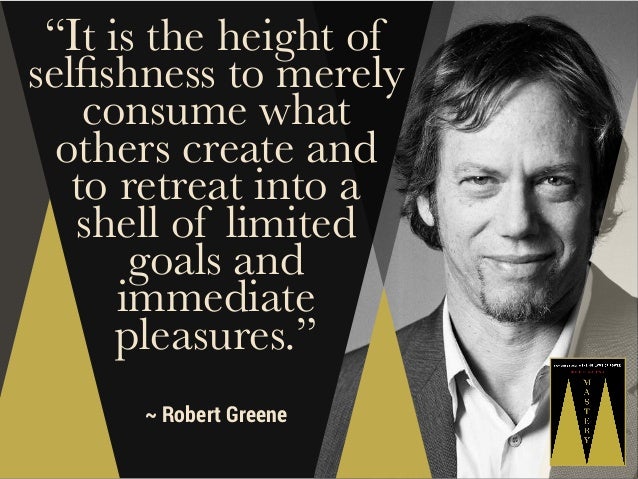
Second, the following photo captures the most compelling idea bouncing around in my brain over the past few months: on balance, people are either creators or consumers. And if you want to have a shot at an extraordinary life, you'd better be moving toward being a creator and away from being a consumer. That's why I'm writing this blog, and why I pursue so many random hobbies. It's also why I don't watch much television and why I'm off social media, and why I'm bothered by those who lack this sensibility. People who spend most of their lives consuming media created by others atrophy their creative powers and end up dependent on the creativity of others for a sense of vitality.

Image result for mastery robert greene

With this motivation in mind, Greene breaks down the three essential steps to attaining creative mastery: choosing your creative task, using creative strategies to loosen and open the mind, and creating optimal conditions for breakthroughs and insights. He finishes by highlighting six emotional pitfalls to avoid and nine distinct approaches various masters have used to attain creative mastery. 

The essential thing in attaining creative mastery is to transcend the "conventional mind" that develops during one's apprenticeship and return to the creative childlike "original mind" with the added knowledge that comes from apprenticeship. But first, we must establish our goal, our life's creative task. This must be realistic yet challenging, open-ended and uncertain, and, crucially, something we are passionate about and which appeals to our sense of unconventionality and "calls up latent feelings of rebelliousness... The sense of having enemies or doubters can serve as a powerful motivating device and fill you with an added creative energy and focus." The creative journey is not for the weak-willed.

Once we find our life's creative task, we must follow the clues to mastery left by the masters who have gone before us. Greene details crucial developmental milestones attained by Mozart, Keats, Edison, Ford, Einstein, Darwin, Da Vinci, Faraday, and Champollion, the decoder of the Rosetta Stone. These include the ability to embrace mysteries and uncertainties and researching as widely as possible to create, as William James expressed it, "a seething cauldron of ideas, where everything is fizzling and bobbling about in a state of bewildering activity." If this can be achieved, "a kind of mental momentum is generated, in which the slightest chance occurrence will spark a fertile idea." An added tack is to engage in physical, artistic, or other kinds of activities outside your work to maintain an openness and looseness of spirit. The more varied the sensual stimulations we experience, the more unique connections are likely to spring forth. This can help us challenge ourselves to think more visually, metaphorically, and analogically, which takes advantage of the visual and associative powers of the mind. And of course, it's handy to always have a notebook or smartphone handy so we don't lose our insights when they occur. 

It's important to avoid the extremes of premature closure ("short-circuiting" the creative process) and permanent skepticism. Though we must always be open enough to explore new ideas and see things from different angles, we also need to challenge ourselves to "put our nickel down" and create an artifact of some kind based on our ideas. Setting deadlines and expectations can create the eustress and tension we sometimes need.

Balancing this need for deadlines is the necessity to avoid impatience, one of the six pitfalls to creativity Greene highlights. To counter this tendency, Da Vinci adopted the motto "ostinato rigore," or "obstinant rigor," for every project he involved himself in. Much like an athlete, we have to learn to love the grind, even the pain, as expressed by one of my high school track mottos, "pain is only weakness leaving the body"! "Although it involves much pain, the pleasure that comes from the overall process of creativity is of an intensity that makes us want to repeat it." And to return to a theme mentioned near the beginning of this post, "Engaged in the creative process we feel more alive than ever, because we are making something and not consuming, Masters of the small reality we create. In doing this work, we are in fact creating ourselves." I would add that the act of creation also puts us in touch with God, the creative energy energy inside each one of us, and is thus a deeply sanctifying act. As we become more in tune with this energy, we will become more sensitive to the pitfalls that lie in wait to pull us off our path.

These snares lie at hand each step of the creative way. One we must always scrupulously avoid is grandiosity, an inflation of the ego that can occur after some measure of success. Think Rocky 3, when Rocky rests on his laurels only to get dominated by a hungry Clubber Lang. Good relationships are the best avenue to avoiding this type of fate. The other pitfalls-- dependency, conservatism, complacency, and inflexibility,--are avoided by religiously keeping an open, fluid mind and a bold, independent, rebellious soul, as described above. A community of fellow creatives can also provide correctives in these areas.

Our greatest task as we emerge from our apprenticeships is achieving creative mastery. Most people falls into a series of pitfalls right out of the gate, never realizing their potential. The techniques shared above highlight these pitfalls and open up the path to creative mastery. Yet we are a distractible species in an age of distraction, and if one thing remains true, it is that low is the gate and narrow is the way to mastery, and few find it. May you and I be two of the few.

Thursday, November 1, 2018

Mushroom burritos- stage 2

After three months with little visible activity in the mushroom department, I was beginning to despair that any mushrooms would ever materialize. Though that outcome wouldn't have made the experiment invalid, I was still feeling like a mycological failure. Plus, I had no tasty mushrooms to look forward to! But when I checked yesterday, voila! A bunch of baby mushrooms had made their way into the world!


The paper burritos are the clear winners, upending my hypothesis. In fact, I have observed no activity in the mulch, hay, or grass burritos, and little activity in the cardboard burritos, either:


My next step (after harvesting, sautéing, and consuming this first generation of mushrooms, of course) will consist of making sawdust burritos. I'll be using pressure treated sawdust initially, but ultimately non-pressure treated sawdust when I am able to obtain that. I hear sawdust is one of the best substrates, so I have high hopes.

Cheers!

Friday, October 26, 2018

Sinners in the Hands of a Loving God Part 2

Chapter 4: The Crucified God

This chapter unrelentingly and convincingly makes a case against most atonement theories, especially the penal substitution and satisfaction theories which posit that God is an offended deity who can only be propitiated with a blood sacrifice. "The sacrifice of Jesus is not a utilitarian payment to an offended deity bound to an economy of appeasement... The beauty of the cross is found in divine forgiveness." In contrast to the conceptualizations of the cross most of us have been handed, Zahnd describes the crucifixion first as a state-sponsored lynching of an innocent man, which is exactly what Plato in The Republic had predicted would happen to a perfectly just man.

One of Zahnd's many powerful points in this chapter is as follows:


The apostle Paul tells us that "in Christ God was reconciling the world to himself." This should not be misunderstood as God reconciling himself to the world. It wasn't God who was alienated toward the world; it was the world that was alienated toward God. Jesus didn't die on the cross to change God's mind about us; Jesus died on the cross to change our minds about God! It wasn't God who required the death of Jesus; it was humanity that cried, "Crucify him! Crucify him!" When the world says, "Crucify him," God says "Forgive them."


A particularly challenging point to my libertarian philosophy is this idea: "In Christianity the supreme value is not freedom but love. We can kill in the name of freedom, but in the name of love we suffer and forgive. Our savior is Jesus Christ crying "Forgive!"-- not William Wallace crying "Freedom!" This, in my mind, is the truly radical heart of Christianity-- which not coincidentally is what is too often missing from the institutionalized church.

He then makes the point that


The justice of God is not retributive; the justice of God is restorative. Justice that is purely retributive changes nothing. The cross is not where God finds a whipping boy to vent his rage upon; the cross is where God saves the world through self-sacrificing love. The only thing God will call justice is setting the world right, not punishing an innocent substitute for the petty sake of appeasement.


This restorative conceptualization of justice is another concept that is sadly missing from most of today's churches. Informed by their theology of a vengeful God, American Christians have set up a vast network of "correctional institutions" that are anything but correctional, and which have destroyed the lives of millions, most of whom are nonviolent offenders of arbitrary and senseless drug laws. Perhaps if we had a proper restorative view of justice, our justice system might actually work the way its supposed to, healing broken lives rather than shattering them.

To sum up the chapter,

  1. God reconciled the world to Himself on the cross, not Himself to the world. He is not the vengeful God requiring blood sacrifice conceived of by ancient tribal peoples, but a God of love and restoration as demonstrated by Jesus Christ, especially on the cross saying "Forgive them."
  2. The radical heart of Christianity is love, not freedom or any other value. Only love can break the cycle of violence the world has been locked in.


Chapter 5: Who Killed Jesus?

In this chapter, Zahnd picks up where he left off in his last chapter, and finishes off the common conception that he cross is the result of God's need for retributive justice. Here is one way he puts it:


In the parable of the prodigal son, the father doesn't rush to the servants' quarters to beat a whipping boy and vent his anger before he can forgive his son. Yet Calvin's theory of the cross would require this ugly insertion into Jesus' most beautiful parable. No, in the story of the prodigal son, the father bears the loss and forgives his son from his treasury of inexhaustible love. He just forgives. There is no payment. Justice as punishment is what the older brother called justice. The only wrath we find in the parable belongs to the Pharisee-like older brother, not the God-like father. Justice as the restoration of relationship is what the father called justice. 


Now, it's understandable that many reading the Bible would come to the conclusion that God desires sacrifice. After all, that's what was commanded in the Old Testament, right? Yet even the Old Testament is not consistent on this, and there seems to be a growing awareness (dare I call it an enlightenment?) that, as David puts it, "Sacrifice and offering you do not desire... burnt offering and sin offering you have not required," or in Hosea's words, God desires "steadfast love and not sacrifice." Hebrews echoes this exact sentiment, as does Jesus when he tells the sacrifice-obsessed Pharisees to "go and learn what this means, 'I desire mercy, not sacrifice.'"

Indeed, it was these Pharisees, and the other "principalities and powers," that, as Paul puts it, Jesus "put to an open shame by his victory over them on the cross." It turns out, viewing the cross as a ritual sacrifice "leaves unchallenged the massive structures of sin that so grotesquely distort humanity... Now the cross forever shames the rick and powerful who seek to preserve their privilege and position through the use of violence. Their pretentious claim that they are wise and just enough to use violent means to achieve good ends is put to everlasting shame. If we claim that it was God who required the crucifixion of Jesus, we seek to clothe with false dignity the very structures of sin that Jesus deliberately stripped bare and put to open shame in his death." True love must subvert the violence and injustice of empire, yet the power of this subversion is lost when we blame God for killing Jesus.

Zahnd presses further. He notes that if Jesus had to be tortured to death for our sins, each of use must deserve the very same thing. And that indeed is what I have heard time and again from the pulpit and read in Systematic Theology books. But of course it isn't true that everyone who has ever lived except for Jesus deserves to be tortured to death. That is "a vicious assault on divine goodness and human dignity" on the level of saying that God commands genocide. What we all need and deserve is love and healing, not torture and death, because we bear the very image of God.

The vision of Jesus dying for our sins should instead be this: "We violently sinned our sins into Jesus, and Jesus revealed the heart of God by forgiving our sins. By saying 'we' violently sinned our sins into Jesus, I mean hat all of us are more or less implicated by our explicit or tacit support of the systems of violent power that frame our world."

To sum up, "What Jesus did on the cross is far more mysterious and beautiful than simply offering himself as a primitive ritual sacrifice... God's action on Good Friday was to surrender his beloved Son to our system. And our system killed him. But on Easter Sunday God overthrew our satanic verdict by raising Jesus from the dead! ... Instead of being organized around blame and ritual killing, the world is to now be organized around forgiveness and cosuffering love.


Chapter 6: Hell... and How to Get There


This chapter is another must-read. Zahnd peels back the centuries of Western misconceptions about hell dating back to Dante and John Calvin, revealing in clear and dramatic fashion Jesus' actual teachings about hell. He repeatedly notes how we "read into" passages things that aren't there-- and gives several examples. Jesus' parables of the rich man and Lazarus and the sheep and the goats are two examples in which Jesus teaches that the wicked-- those who inflict evil on others-- are condemned. Never once is a sinner's prayer or somehow "accepting Jesus into your heart" mentioned. Neither is it mentioned in all of the evangelistic sermons detailed in Acts. Rather,


According to Jesus, the avoidance of afterlife condemnation is not based upon being able to give particular answers to abstract theological questions cribbed from John Calvin and labeled "faith" but on how one actually lives his or her life. Jesus certainly did not lay the foundation for an afterlife theology that claims all non-Christians go to hell. This has become a common way of thinking about heaven and hell-- "Christians go to heaven; non-Christians go to hell"-- but it is not based on anything Jesus ever said! ... Life is not an elaborate testing center for afterlife placement based on theological acumen... The New Testament teaches that it is Christ who judges how we have lived our lives: "For all of us must appear before the judgment seat of Christ, so that each may receive recompense for what has been done in the body, whether good or evil."


The second half of the chapter draws upon CS Lewis' conception of heaven and hell in The Great Divorce, where the damned "enjoy forever the horrible freedom they have demanded, and are therefore self-enslaved just as the blessed, forever submitting to obedience, become through all eternity more and more free." His key point is that hell is simply the state that results when a person cuts herself off from giving or receiving love. God's fiery love, which is warmth and light to those who receive it, is indeed torment to those who refuse it. Whether it is truly eternal is anyone's guess-- Zahnd speculates that "hell is as eternal as the human capacity to resist God, and thus hell is potentially eternal."

Lest he be misinterpreted, Zahnd reinforces his conclusion with a thought experiment comparing hypothetical women named Becky, from Kalamazoo, Michigan, and Belqees, from Kabul, Afghanistan. Becky is a Christian but a mean, self-righteous, and judgmental Pharisee. Belqees is a devout Muslim who is a kind and generous soul who regularly cares for the poor and sick. What happens when they die? Only a monstrous theology would condemn Belqees to hell while escorting Becky to her "finely appointed luxury mansion. And in response to the common objection that "only Jesus can save," Zahnd responds,


"Yes and amen." And who are you to tell Jesus whom he can and cannot save?! Are you going to tell Jesus he cannot save Belqees? Jesus can save whomever he wants. Jesus is Lord... This thought experiment, which I've given to many people, often leads to the objection that such a theology would lead to a lack of motivation for evangelism. But this is true only if you think the gospel is about the postmortem issues of heaven and hell, a subject never raised in the apostolic sermons in Acts. The truth is that the gospel is a joyful proclamation that the kingdom of God has arrived with the incarnation and resurrection of Jesus Christ... If you don't know how to preach the gospel without making appeals to afterlife issues, you don't know how to preach the gospel!


The odious dogma that only Christians go to heaven has needlessly and tragically driven countless away from the faith. We Westerners would do well to follow the humble lead of our Eastern Orthodox brethren in this matter, who believe God is great enough to save anyone he wants. May we all avoid the belief that only those who think like us wind up in heaven, for that belief is itself a highway to hell. Just look at fundamentalists like Westboro Baptist. They're on the first bus there.


Third Quarter Report

I'm a few weeks late getting this out, but here are the latest developments:

-Mindy and I are doing very well, and both of us are learning how to build an ever stronger connection. We also had a wonderful 3rd anniversary in the West Jefferson area. As I've reflected on connection as one of my two focuses of the year, I've realized in a deeper way that it must be a primary focus of each stage of my life, not just this year. More on that in an upcoming post.

-I've started a year-long leadership seminar at the hospital. We've only had one meeting, but I'm in a great group and excited to tackle a project with them next year.

-I'm working my way back through Sinners in the Hands of a Loving God, which has become my top religious book of the year. Brian Zahnd's take on central Christian issues such as salvation, the gospel, the afterlife, and prophesy has been a major wind in my spiritual sails as I continue to reconstruct what I believe as a post-Reformed, post-evangelical, newly progressive Christian.

-In that vein, Mindy and I have found a service we both feel at home in at Boone United Methodist Church, and am looking forward to deepening connections there over the coming months.

-We bought kayaks! Mindy and I took our new boats out for their maiden voyages just the other day, and it was every bit as magical as I had hoped. Looking forward to many a paddle on the New River and beyond. Photos here:


-I'm still biking, swimming, and starting to run more in anticipation of some triathlons next year. I'm also getting more into Natural Movement.

-Pepper had to get surgery for a paw injury last month, but he is finally healed. Lula is as crazy as ever. Molive the cat is great. Thistle the rabbit did have a prolonged bowel obstruction that has now healed with the addition of fresh greens to her diet. We are growing to love our animals more each day.

-Mindy and I went biking on the Creeper Trail with Norm and Cassidy Hogan and their kiddos a couple weeks ago. It was chilly but fun!


That's all I can think of for now! Deeper reflections coming soon.

Thursday, October 11, 2018

Fall Reflection: Connection


We are brimming with bonds.
Physiologic connections constitute our being. 
Telescopes, microscopes stared into darkness
And found no match to our complexity
Mind-boggling mesh of synapses, receptors
The id, ego, super-ego
Explanations unsettling in their inadequacy
Mapped in colorful complexity
Still so far beyond our ken. 

Know thyself.
The most ancient phrase.
The most wise.
Know thyself.
What ties you together?

Wives, husbands, mommies, daddies,
First-order bonds, identities
Messy words like love
Conceal as much as reveal.
We pretend to understand each other--
Till confronted by how we have not. 
How distorted our pictures of others
Our gaze fixed on ourselves.
What can refocus, what can refine?
Let thyself be humbled!
Tear that too-strong tie.

Charlatans predate primate relations
Tangle ties meant for tribes
Salesmen's spiderwebs stick 
Stripping the seams of society.
So we must build walls,
We must skepticize,
We must ever say, 
Put me on your no-call list.
Blessed it must not be, 
The tie that binds.

Triggers make connections, but destroy.
Knots can be tangled or clean.
Glue defaces as well as binds
Tape turns on itself.
How fraught, our connections, how fragile
What delicate touch we need with the other
What science, skill, experience, what sensibilities
What an art is love.

Love--
Creaturely, embodied, yet divine
For creatures, others, and the divine.
Our utmost challenge:
Untangle, retie that knot
So blessed can be the tie that binds.


Thursday, August 30, 2018

Swimming and biking update

A couple weeks ago, I swam in the Watauga Lake Triathlon as part of a relay team, which was a blast. We were totally average, coming in as the 6th out of 9 relay teams, but we're legends in our own minds. "2 docs-n-crisis" will never be forgotten. Here's my team, and my super-serious-looking dive-- check out those triceps!


I'd been able to swim 2-3 times per week the last few months, and it was nice being able to focus on swimming leading up to the race. Though my times plateaued over the month leading up to the race, I did have a great week of open-water training in New Hampshire the week before the swim, which improved my technique tremendously.

Without a major upgrade in my upper body strength, I'm probably not going to be able to significantly improve my times in the water. I do hope to get stronger in the home gym over the next year, but I doubt I'll ever reach the ideal BMI for a swimmer, which is 24. But I do plan to maintain the past year's gains in the pool with weekly swims.

With the Watauga Lake swim behind me, I've shifted my focus onto biking. In addition to a couple other workouts, I'll be in the saddle a minimum of twice per week for the next several months. I've started with 8-10 mile rides near my house, which have some really great hills, very little traffic, and beautiful scenery. I'll gradually inch up the mileage every week, much like I did with swimming last year. My goal is to do three triathlons next year. I'm hooked!